What Voltage Is An Electric Fence For Cattle . Like any electrical circuit, the positive wire carries the voltage and amps to the load (in this case the fence and anything that touches it). 9 rows upon contact with the fencing, animals will be shocked, remember the shock and know. Customer reviews Kuguo Voltage Tester Neon 10 from www.amazon.com How many volts is an electric cattle fence? How to construct an electric fence for cattle. Keep in mind that bigger is better, until the point that induction occurs.
Voltage Across Capacitor Formula In Rc Circuit. The voltage rushes across the capacitive reactance of the capacitor after the current by −90 °. Forced response of rc circuits for the circuit shown on figure 15 the switch is closed at t=0.
How does a RC circuit work, especially the charges on the from www.quora.com
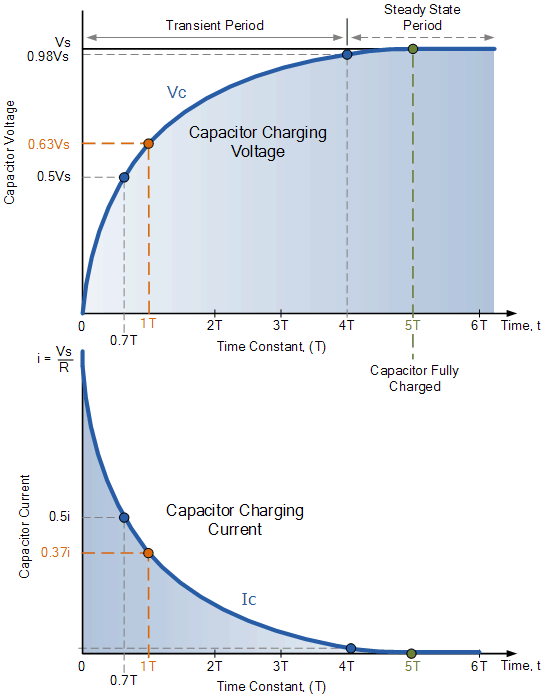
As the voltage at t = 0 across the capacitors plates is at its highest value, maximum discharge current therefore flows around the rc circuit. For r ohms and c in farads, rc is in seconds for mω and µf, rc is seconds for kω and µf, rc is ms i=c dv dt = v i−v r v=v i+ae −t rc v=v i 1−e −t (rc) @ 1rc 63% of. Current and voltage are in phase at the ohmic resistance.
As Electrons Start Moving Between Source Terminals And Capacitor Plates, The Capacitor Starts Storing Charge.
The transfer function from the input voltage to the voltage across the capacitor is Because the voltage v is proportional to the charge on a capacitor (vc = q/c), the voltage across the capacitor (vc) at any point during the charging period is given as: The voltage v out is the voltage across a capacitor, which can’t change instantaneously, so v out(10ms+) = v out(10ms ) = 5v.
So Applying This Law To A Series Rc Circuit Results In The Equation:
Here, ‘ i ’ is the charging current flowing through the circuit, and is calculated as, i = v s r. `v_r= ri` and `v_c=1/cinti dt` kirchhoff's voltage law says the total voltages must be zero. Now, you can find the capacitance of the circuit, by using the above formula, here, c 1 = 10uf and c 2 = 1uf.
For R Ohms And C In Farads, Rc Is In Seconds For Mω And Μf, Rc Is Seconds For Kω And Μf, Rc Is Ms I=C Dv Dt = V I−V R V=V I+Ae −T Rc V=V I 1−E −T (Rc) @ 1Rc 63% Of.
Viewing the circuit as a voltage divider, the voltage across. This corresponds to a step function for the source voltage vs as shown on figure 16.we would like to obtain the capacitor voltage vc as a function of time. What do you think happens when the switch is closed?
R Vo C ≡ R Vo C Figure 5 2.
Formula for calculating a series circuit. Voltage across the capacitor as it charges. The simplest rc circuit is a capacitor and a resistor in series.
The Current Is The Same At Every Measuring Point.
For ωrc =1 the phase φ=−450 and the amplitude 1/ 2 1/ 2 2 a ==vvoo + r c cos( /4) 2 cos( ) vo ωπt − vto ω The logic isn’t that the output voltage can’t change instantaneously, it’s the the voltage across the capacitor can’t.) Ohm's law applies to the entire circuit.


Comments
Post a Comment